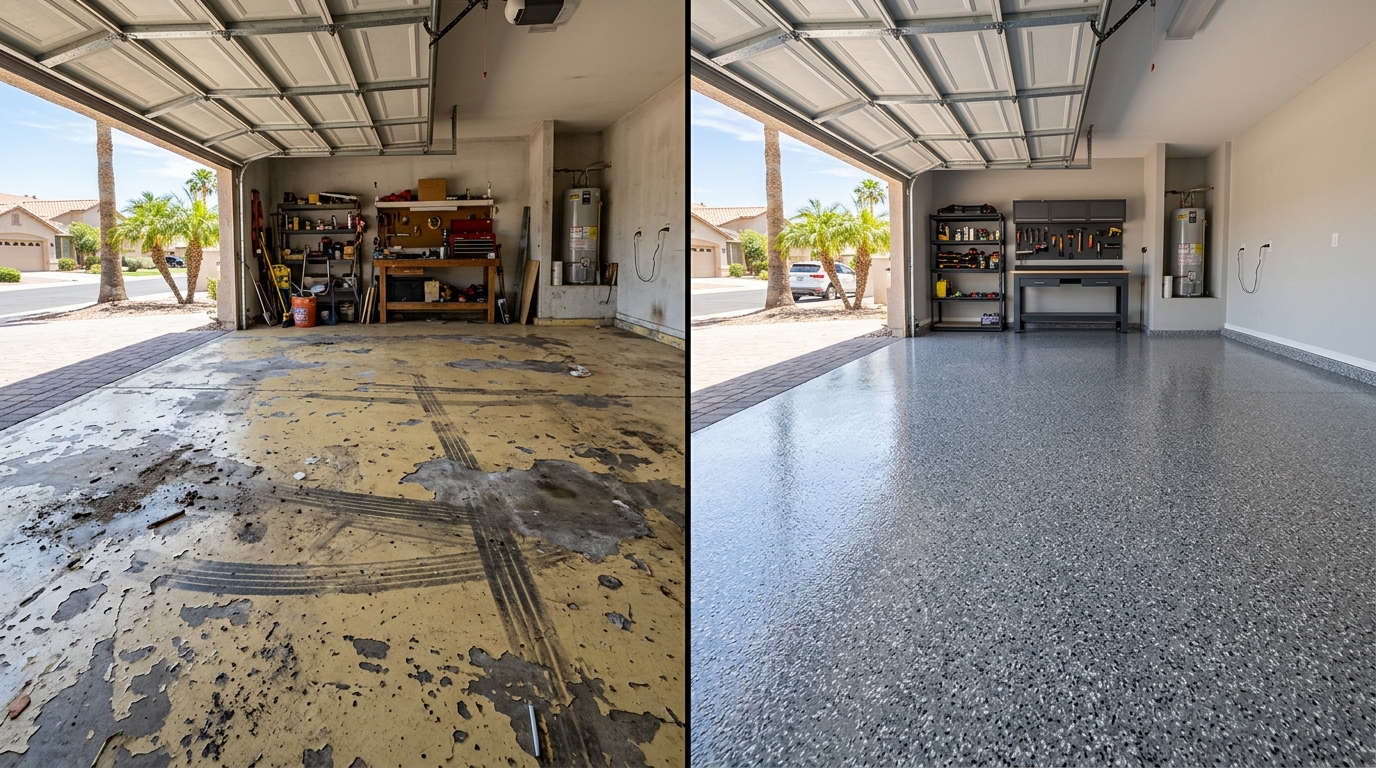
Ask any honest coatings professional what causes floors to fail and you'll get the same answer: it's almost never the product. It's the prep. Industry estimates consistently attribute the overwhelming majority of coating failures — delamination, bubbling, peeling — to inadequate surface preparation, not coating chemistry.
This guide explains exactly what proper prep involves, so you can evaluate any contractor's process (including ours).
Why Concrete Is Harder to Coat Than It Looks
Fresh-finished concrete has a smooth, dense surface layer called laitance — a weak film of fine particles and cement paste floated to the top during finishing. Coatings applied over laitance bond to that weak layer, not to the structural concrete. The coating doesn't fail; the laitance under it does, and the coating goes with it.
Add a few years of real life — oil drips, tire residue, household chemicals, curing sealers from the original builder — and you have a surface no coating can grip.
Mechanical Grinding vs. Acid Etching
This is the single most important question to ask any installer: "How do you prep the slab?"
Acid etching (the shortcut)
DIY kits and budget installers use muriatic acid washes to roughen the surface. The problems:
- It doesn't remove laitance uniformly — it just texturizes the weak layer.
- It can't touch sealers, oil contamination, or old coatings.
- Acid residue left in the pores actively interferes with adhesion.
- Results vary wildly across a single slab.
Diamond grinding (the standard)
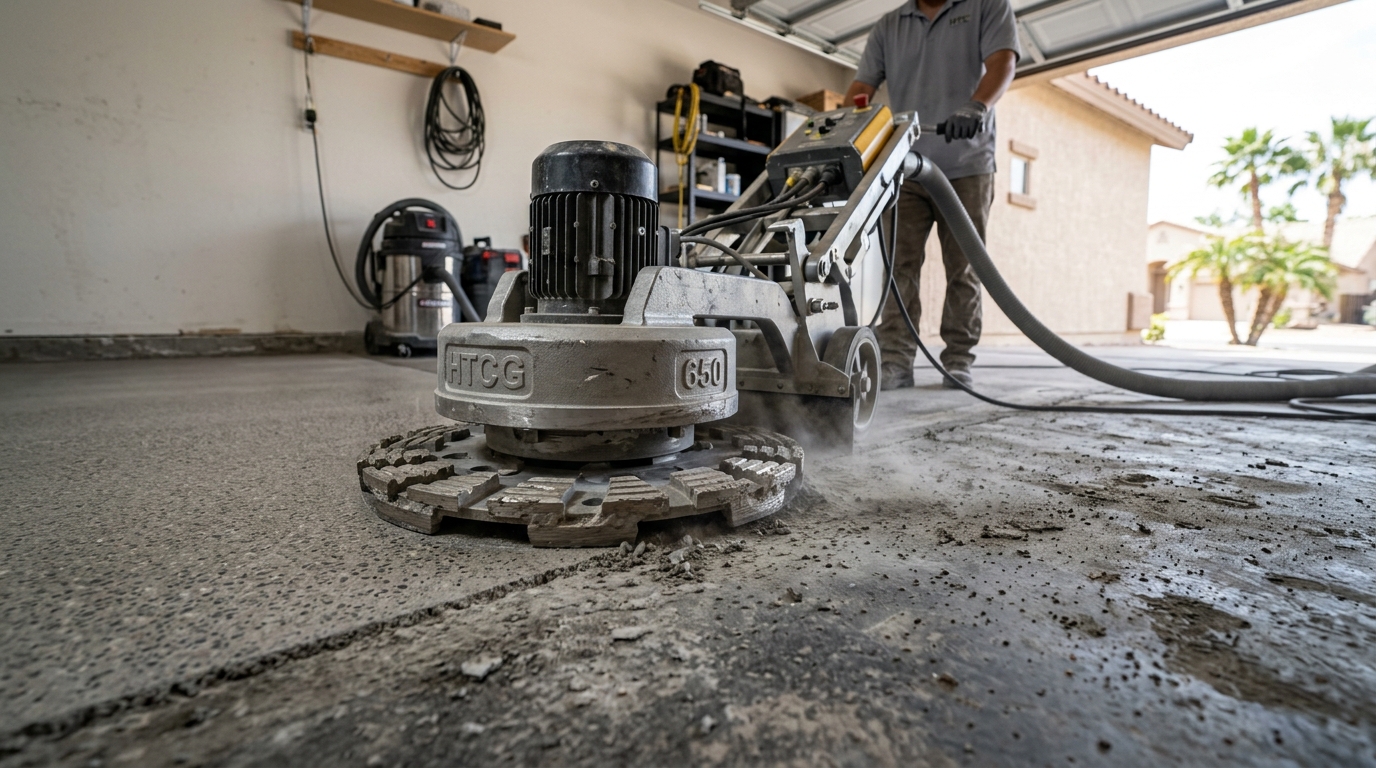
Professional prep means planetary grinders with diamond tooling, removing the top layer of the slab entirely:
- Strips laitance, sealers, and contamination down to clean, structural concrete.
- Opens the pores to a measurable concrete surface profile (CSP) that resins can mechanically key into.
- Dust is captured with HEPA vacuum systems — no mess in your home.
At Vantyx, this is Phase 1 of TRI-BOND™: LOCK prep. We don't own acid. We own diamonds.
The Full Professional Prep Checklist
Here's what happens before a drop of coating touches your floor:
- Moisture evaluation. Concrete transmits ground moisture as vapor. Excessive vapor pressure will blister any coating. Phoenix's dry climate helps, but irrigation, slab age, and drainage all matter — so we evaluate every slab rather than assume.
- Diamond grinding of 100% of the surface, including edges and corners with dedicated edge grinders.
- Crack and spall repair. Cracks are chased open, filled with rigid polyurea repair compound, and ground flush. Pitting and spalls are patched. The repairs become invisible under full flake broadcast.
- Joint treatment. Control joints are filled or honored by design, depending on the slab and the homeowner's preference.
- Final vacuum and tack. A surgically clean surface, verified before base coat.
Authoritative DIY resources like Bob Vila's garage flooring guides acknowledge the same truth: preparation quality determines coating lifespan more than any other variable.
Why This Matters Even More in Phoenix
Arizona slabs face thermal cycling that northern garages never see — surface temperature swings of 50°F+ in a single day are routine in Glendale or Tempe summers. Thermal movement stresses the bond line constantly. A coating that's mechanically keyed into ground concrete shrugs it off; a coating sitting on acid-etched laitance lets go.
Heat also accelerates every chemical reaction, including the slow failure of a bad bond. That's why budget floors in Phoenix fail in 2–3 years instead of the 5–7 they might survive elsewhere — the same reason epoxy underperforms here generally.
Questions to Ask Any Installer
- Do you diamond-grind every square foot, or acid etch?
- How do you handle cracks and spalls — filled and ground flush, or just coated over?
- Do you evaluate moisture before installing?
- Is your base coat moisture-tolerant?
- Will you warranty against delamination — in writing, for how long?
If an installer hesitates on any of these, keep shopping. If you'd like to see our answers in person, book a free in-home estimate — we'll inspect your slab and explain exactly what it needs. You can also read more about the full TRI-BOND™ three-phase system here.
Frequently Asked Questions
The Vantyx Team
Vantyx Coatings LLC installs the TRI-BOND™ polyaspartic garage floor coating system across the Phoenix Metro Area. Licensed, insured, and obsessed with floors that last a lifetime.